I Hope Looking at Our Phones in Public Becomes Embarrassing
On attention, social norms, and the strange things we’ve learned to accept.
I have a somewhat unusual hope for the future.
I hope that one day, looking at your phone in public becomes a little embarrassing.
Not illegal. Not forbidden. Not even necessarily frowned upon in any official capacity.
Just… vaguely unattractive.
The way smoking a cigarette in the middle of a restaurant would feel today. The way certain behaviors, once perfectly ordinary, eventually become things we instinctively recognize as inconsiderate.
I hope we reach a point where someone feels the urge to scroll through Instagram while sitting at dinner with friends and thinks, Maybe I should step outside for a minute.
I hope we start sneaking around street corners to check our feeds. Ducking away from the party to get a quick fix. Excusing ourselves to indulge in five minutes of mindless scrolling, then returning to the world of the living.
I realize how ridiculous that sounds. But I also wonder whether it sounds ridiculous only because we’ve become so thoroughly accustomed to the alternative.
We spend so much time talking about how to control our relationship with our phones. Screen-time limits. Digital detoxes. Apps designed to keep us from opening other apps.
But I wonder whether we’re overlooking something far more powerful.
What if changing our habits isn’t entirely a matter of individual discipline? What if it begins with changing what we collectively consider desirable?
The Things We Learn to Accept
There was a time when smoking was everywhere.
People smoked in restaurants, in offices, on airplanes, in living rooms. They smoked while holding conversations, conducting business, raising children. Cigarettes were woven so seamlessly into ordinary life that their presence barely warranted acknowledgment.
And then, gradually, something changed.
The science mattered, of course. So did public policy. But something else happened, too, something less tangible and perhaps just as fascinating.
Our collective perception changed.
A behavior that had once appeared sophisticated, glamorous, and socially unremarkable began to look different. It became less desirable. Less considerate. Less attractive.
People began to think differently not only about the physical consequences of smoking, but about what it meant to subject everyone around them to it. And eventually, the social expectation reversed.
Instead of nonsmokers having to accommodate the habit, smokers were expected to excuse themselves.
I find that transformation fascinating because it reminds me that the things we consider normal are not necessarily natural, inevitable, or permanent.
They’re agreements. Unspoken, collective agreements about how we ought to behave around one another.
And agreements can change.
The Invisible Secondhand Smoke of Distraction
I know the comparison isn’t perfect. A person scrolling through their phone isn’t exposing everyone nearby to carcinogens. The physical consequences of secondhand smoke and the social consequences of digital distraction are not the same.
But I keep returning to the metaphor.
Because I wonder whether there’s a similar kind of secondhand effect to our distractedness. Something harder to measure, but still very real.
What happens to a conversation when one person repeatedly glances at a screen? What happens to the atmosphere of a dinner table when everyone has placed a small portal to somewhere else beside their plates?
What happens to a child’s understanding of attention when the adults around them are physically present but perpetually available to an invisible audience?
And what happens to us, collectively, when we stop expecting one another to be fully here?
There’s something quietly heartbreaking about the possibility that we might spend our lives surrounded by people who are only partially with us.
Not because they don’t love us. Not because they don’t care.
But because we’ve built a world in which giving someone our undivided attention has become an increasingly deliberate act.
Something we have to remember to do.
I Don’t Want to Be a Snob About This
There’s an obvious problem with my argument: I have no idea what someone is doing on their phone.
They might be answering a message from their child, navigating an unfamiliar city, managing a crisis, or simply taking a much-needed break. And even if they’re doing absolutely nothing important, who am I to judge?
I am, after all, spectacularly guilty of the very behavior I’m describing.
I scroll when I’m bored. I reach for my phone during moments of silence. Sometimes I find myself staring at a screen without even remembering what I intended to look at in the first place.
I recognize the absurdity of the behavior while participating in it almost automatically. And I suspect I’m not alone.
So no, I don’t want to promote a culture of public humiliation or moral superiority.
But I do wonder whether we’ve become so uncomfortable with the idea of judgment that we’ve forgotten the value of social expectations.
Social norms aren’t always instruments of cruelty. Sometimes they’re expressions of what a community has decided to protect.
We lower our voices in libraries. We try not to interrupt. We acknowledge someone speaking directly to us. These aren’t laws of nature. They’re small acts of collective consideration.
And perhaps we could develop a few more.
The distinction matters to me. I don’t want people to feel ashamed of themselves for using their phones.
I want the habit of reflexively disappearing into one to become a little less appealing.
What If Being Present Became Desirable Again?
I think about how much human behavior is shaped by what we find attractive.
Not merely physically attractive, but socially attractive. What we admire. What we associate with confidence, maturity, sophistication, warmth, or self-possession.
Imagine if we began to admire the person who could sit comfortably through a string of quiet moments without reaching for a phone.
Imagine if looking someone in the eyes and giving them your undivided attention felt effortlessly sophisticated.
If being unreachable for an afternoon suggested a full and interesting life rather than a failure to respond.
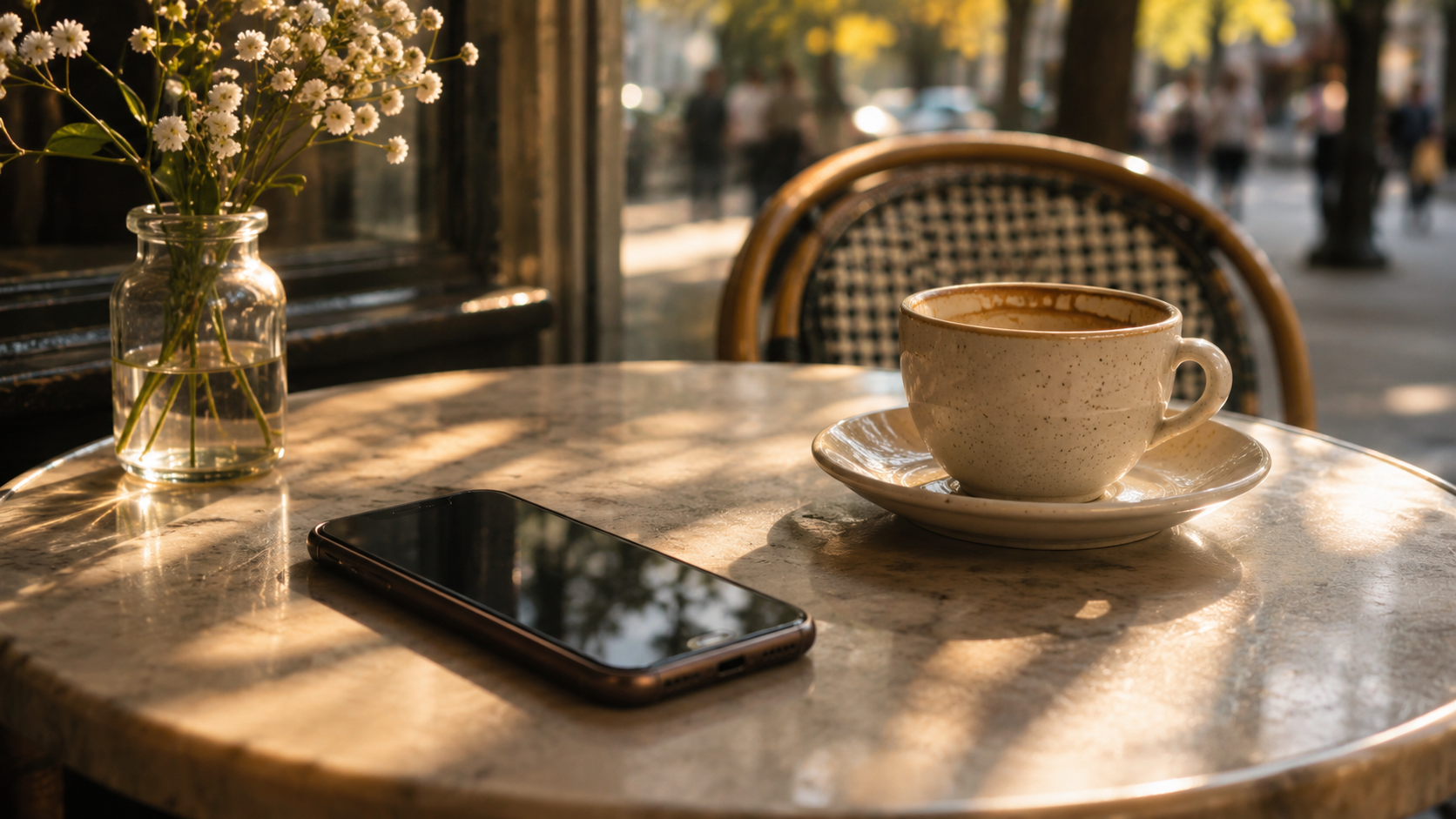
If a person sitting alone at a café, simply observing the world, seemed more intriguing than someone endlessly refreshing a feed.
If we began to associate constant scrolling not with connectedness, productivity, or importance, but with a certain lack of self-command.
Not because the person doing it was somehow inferior.
But because the behavior itself had lost its appeal.
I wonder how quickly our habits might change if our collective sense of what was desirable changed first.
We talk endlessly about individual discipline, as though every moment of distraction is a personal failure to be corrected. But human beings are social creatures. We take our cues from one another. We absorb expectations almost unconsciously.
We want to belong.
And while that instinct can lead us toward some terrible things, it can also lead us toward better ones.
What a remarkable use of peer pressure it would be, to make presence fashionable again.
Maybe we could begin to admire the person who doesn’t need to demonstrate how busy, connected, or available they are.
The person who can let a moment simply be a moment.
Who can sit through dinner without checking whether something more interesting is happening somewhere else.
Not because they’ve mastered some extraordinary act of self-denial.
But because they’ve remembered that there’s something worth paying attention to right in front of them.

The Small Grief of Being Elsewhere
I think what troubles me most isn’t really the technology. It’s the ease with which we surrender moments of our lives.
A moment of boredom. A pause in conversation. The few minutes waiting for a meal. The walk from the parking lot to the front door.
These tiny spaces used to belong to us. To our thoughts. To observation. To the possibility of noticing something unexpected: A stranger’s expression. The weather changing. A funny exchange at the next table. A question we hadn’t thought to ask ourselves.
Now those spaces are so easily filled.
And I can’t help but wonder what happens to a person when every unoccupied moment becomes an opportunity to consume something.
When do we think? When do we notice? When do we become acquainted with the contents of our own minds?
When do we allow the world to surprise us?
There’s a particular sadness in imagining that we might reach the end of our lives having been present for every major event, yet absent for so much of the ordinary living that happened in between.
Because life is overwhelmingly made of ordinary moments.
And perhaps that’s what makes this worth caring about.
Not because every glance at a phone represents some profound loss. Sometimes we’re just checking the weather or answering a text. Sometimes we’re tired and want to look at something silly for five minutes.
But because the habit of looking away has become so effortless that we rarely stop to consider what we’re looking away from.
And I wonder whether we might eventually come to miss those little pieces of our lives.
The ones we barely noticed giving up.
Maybe We’ll Look Back Someday..
I sometimes imagine people fifty years from now looking at photographs of our era.
- A restaurant full of people bent over illuminated screens.
- Parents at playgrounds, looking down while their children look up.
- Couples sitting together in silence, each absorbed in a different world.
- Crowds waiting for something to happen, all staring into their palms.
- And I wonder what those future observers will think.
Perhaps they’ll find it entirely unremarkable. Perhaps they’ll be even more absorbed in technologies we can’t yet imagine.
But I hope not.
I hope they’ll look at those photographs with the same bewilderment we feel when we see old images of smoke-filled airplanes and restaurants.
They really did that everywhere? Even when they were together? And nobody thought it was strange?
I hope the answer will be that eventually, we did. Past tense.
That we began to notice. That we decided the people standing in front of us deserved something more than the leftover fragments of our attention.
That we stopped treating every quiet moment as an inconvenience to be escaped.
And that, somewhere along the way, we rediscovered the peculiar pleasure of simply being exactly where we are.
I don’t expect us to abandon our phones. I wouldn’t want us to. They’re extraordinary tools, and they’ve made countless parts of life better.
But I do hope we eventually become a little more discreet about our compulsions. A little less comfortable disappearing into a screen while the world continues around us.
A little more embarrassed to be caught missing our own lives.
Not because someone might judge us.
But because we might finally come to believe that our attention is worth protecting.
And that the person across the table is worth giving it to.
Maybe we don’t have to wait fifty years for our habits to look strange. Maybe we can begin changing what we admire now.
Not by policing strangers or pretending we’re above the temptation ourselves, but by making a different kind of presence visible. By giving our attention freely. By treating the ability to be fully here as something quietly admirable.
Maybe the most radical thing we can do in an age of infinite connection is make being fully present with one another feel ordinary again.